News
PSBJ: Melinda French Gates-backed waterfront restoration opens ahead of World Cup
Posted on
This story was originally published by the Puget Sound Business Journal on June 8, 2026.
By Akielly Hu
Story Highlights
- Private donors funded a $56 million waterfront park renovation project.
- Myrtle Edwards and Centennial parks reopened to the public June 4.
- Private donors will fund the first five years of maintenance.
A 2-mile-long stretch of waterfront parks and trails connecting downtown Seattle to the Expedia Group’s headquarters on Elliott Bay has reopened after a $56 million renovation.
The project, Elliott Bay Connections, was funded entirely by private donors, including Melinda French Gates, MacKenzie Scott, the Diller-Von Furstenberg Family Foundation and Expedia Group. It included the renovation of Myrtle Edwards and Centennial parks and the construction of a new pathway on Alaskan Way from Pier 62 to Olympic Sculpture Park, which opened in April.
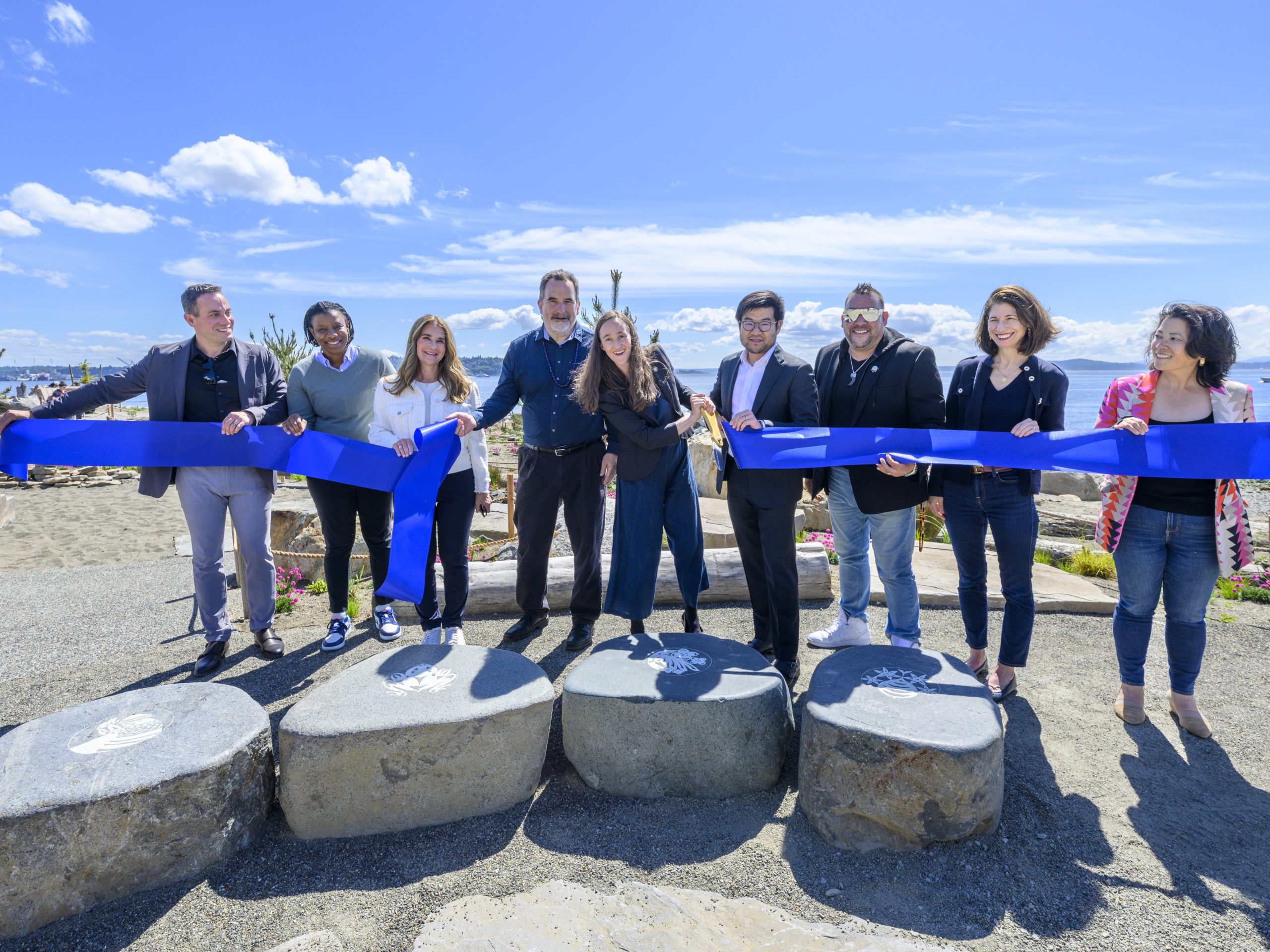
Myrtle Edwards and Centennial parks reopened to the public June 4, marking the completion of the project.
During 15 months of construction, crews expanded the Myrtle Edwards beach coves, built a children’s play area and constructed accessible pedestrian and bike trails. A new building in Centennial Park called haʔłali, a Lushootseed word meaning “The Good Place,” has restrooms and a Café Hagen.
At a media event Friday, Downtown Seattle Association President and CEO Jon Scholes touted what he described as rapid progress for a restoration that involved 60 permits.
“It shows that Seattle gets big things done,” he said as trains roared past the railway adjacent to the waterfront.
The project was first announced in 2023, with a target opening before the first World Cup match this month.
An abundance of native plantings, benches, wayfinding signs and paved trails transformed the previous parks.
“We wanted to let these parks be what they want to be. We didn’t think that on our shoreline they wanted to just be lawns,” said Lara Rose of Walker Macy, the landscape architecture firm in charge of the design.
Leaders from the Suquamish, Samish and Muckleshoot tribes helped incorporate Indigenous design features, such as the 13 moons of the Coast Salish lunar calendar carved into boulders throughout the park.
The haʔłali amenities building, designed by architect Alfred Waugh of the British Columbia-based firm Formline, replaces a former cinderblock public restroom facility. Its arced design facing the water and use of yellow and western red cedar reflect the Coast Salish peoples’ relationships to the region’s plants and coastline, Waugh told the Business Journal.
A central walkway frames the bay view, designed to feel like a greeting to the ocean, Waugh said.
“It makes gestures architecturally, even though it’s a small building,” he said.
In 2023, the full project cost was estimated at $45 million. Costs rose to $56 million due to complex underground utility work, storm surge preparations and other design changes, according to the project website.
Private donors will fund the first five years of maintenance. The city of Seattle owns Myrtle Edwards Park and the Port of Seattle owns Centennial Park.
The DSA, which helped implement the project, plans to track foot traffic at the parks after the renovation, as well as how long people linger.
“That’s the big game-changer for what these improvements mean,” Scholes told the Business Journal. “It’s not just a park to pass through, it’s a park to enjoy.”