News
Mayor, DSA and Partners to Scale Pioneer Square Homelessness Pilot Citywide
Posted on
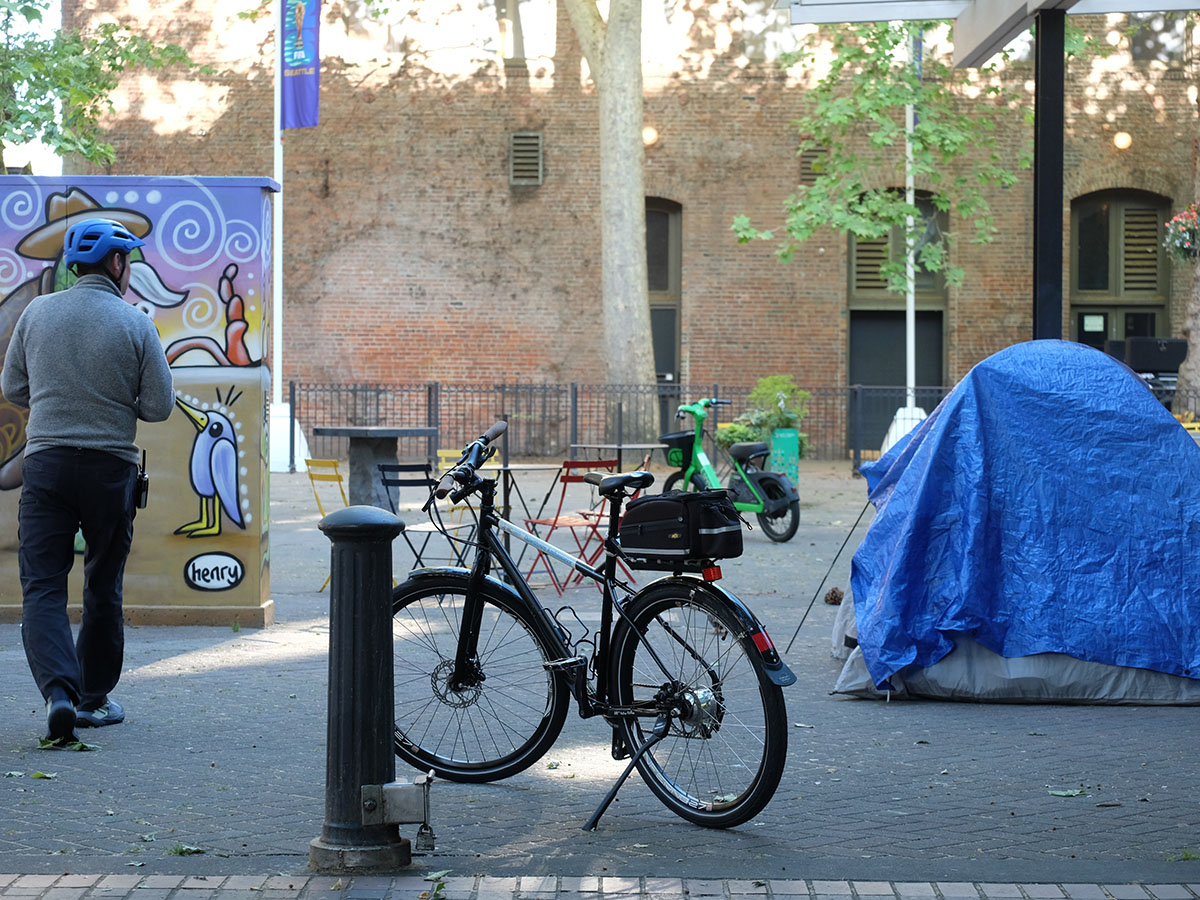
Mayor Katie Wilson, members of the City Council, the Downtown Seattle Association and a broad coalition of business, neighborhood and service-provider leaders announced on Oct. 21 a new strategy to reduce unsheltered homelessness in Seattle. It expands on Streets-to-Housing, a pilot that DSA, Purpose. Dignity. Action. and REACH led in Pioneer Square this summer.
The approach draws on a framework developed by Community Solutions, a national nonprofit whose model has produced results in cities including Denver, Kansas City and Houston. Outreach teams and service providers build a list of everyone sleeping outside in a neighborhood, then work to match each person with the shelter or housing that fits their needs. The strategy prioritizes people with the greatest needs, including those with mental health or addiction challenges, and those living in public spaces.
What the pilot showed
The Pioneer Square effort launched in June, ahead of the World Cup matches at Lumen Field. Over six weeks, it moved 70 of 80 people into shelter or housing, with four reunited with family outside Seattle. Nearly 80% remain inside today. According to the mayor’s office, 47% of those served had been homeless for more than three years, and 77% lived with addiction or mental illness. Only three people declined all services.
As The Seattle Times reported, that is a far higher success rate than typical encampment clearings, where people are offered whatever shelter is available, even when it’s a poor fit. The same approach was used during the pandemic, and Washington later expanded it to encampments along state highways, where 95% of people moved indoors.
“Homelessness is not a natural occurrence,” Wilson said. “It is a policy failure.”
“Our public parks and public sidewalks belong to the public,” she added, saying the approach is how the city can meet that expectation “without merely sweeping human beings around our city from one block to the next.”
What comes next
The mayor said the outreach strategy will largely use existing resources, but its success depends on more shelter. Her proposed budget includes $37 million for shelter expansion. Her team is aiming for about 960 new shelter units over her first two years, roughly 400 of them operating by the end of this year. Wilson said all new beds will be reserved for people identified by outreach workers as most in need.
The Times reported that Wilson did not say where the model would be replicated first or what the full cost would be. It also noted that the new units, while a big increase after years with almost none built, remain well short of the number of people living outside. The mayor also said encampment clearings will continue at the current pace.
DSA’s role
DSA President & CEO Jon Scholes joined the mayor and Councilmembers Bob Kettle, Eddie Lin and Dionne Foster at the announcement.
“We know what works,” Scholes said. “With the help of Community Solutions, we’ve developed a playbook that has proven successful and can be replicated across the city.”
On the cost, Scholes: “Yes, it’s expensive. But you know what’s also expensive is the status quo.”
He pointed to emergency room visits, the strain on small businesses and extra security and cleaning.
Scholes acknowledged the skepticism many people feel after more than a decade of false starts.
“I don’t blame anyone in this city or region for the rush of cynicism or skepticism they may feel when they hear the words ‘new homelessness strategy,’” he wrote in a LinkedIn post after the announcement.
But he said he’s optimistic because the approach is grounded in “solid data tracking, transparency, reporting, coordination” and because there is “broad support for this strategy among a diverse coalition of leaders and organizations.”
“None of this will be easy, but it’s entirely possible,” he wrote. “Seattle can rebuild public trust and confidence and importantly help those suffering most get off the streets and regain purpose.”