News
A Look Inside Our Streets-to-Housing Pioneer Square Push
Posted on
*This story was published Aug. 27, 2026, using data compiled the week ending July 24, 2026.
…
The sun had only been up for about 45 minutes when Jeffrey started his rounds, a radio on one shoulder, a satchel on the other. Between 6:30 and 7:30 a.m. on Thursdays, he wasn’t representing DSA/MID’s Community Safety & Hospitality ambassador team — not in uniform, anyway. He traded the bright, recognizable blue and yellow for quiet, “regular” clothes.
“We’re supposed to be incognito for a couple hours,” he said, pointing to his radio and satchel. “Doesn’t always work. We stand out anyway.”
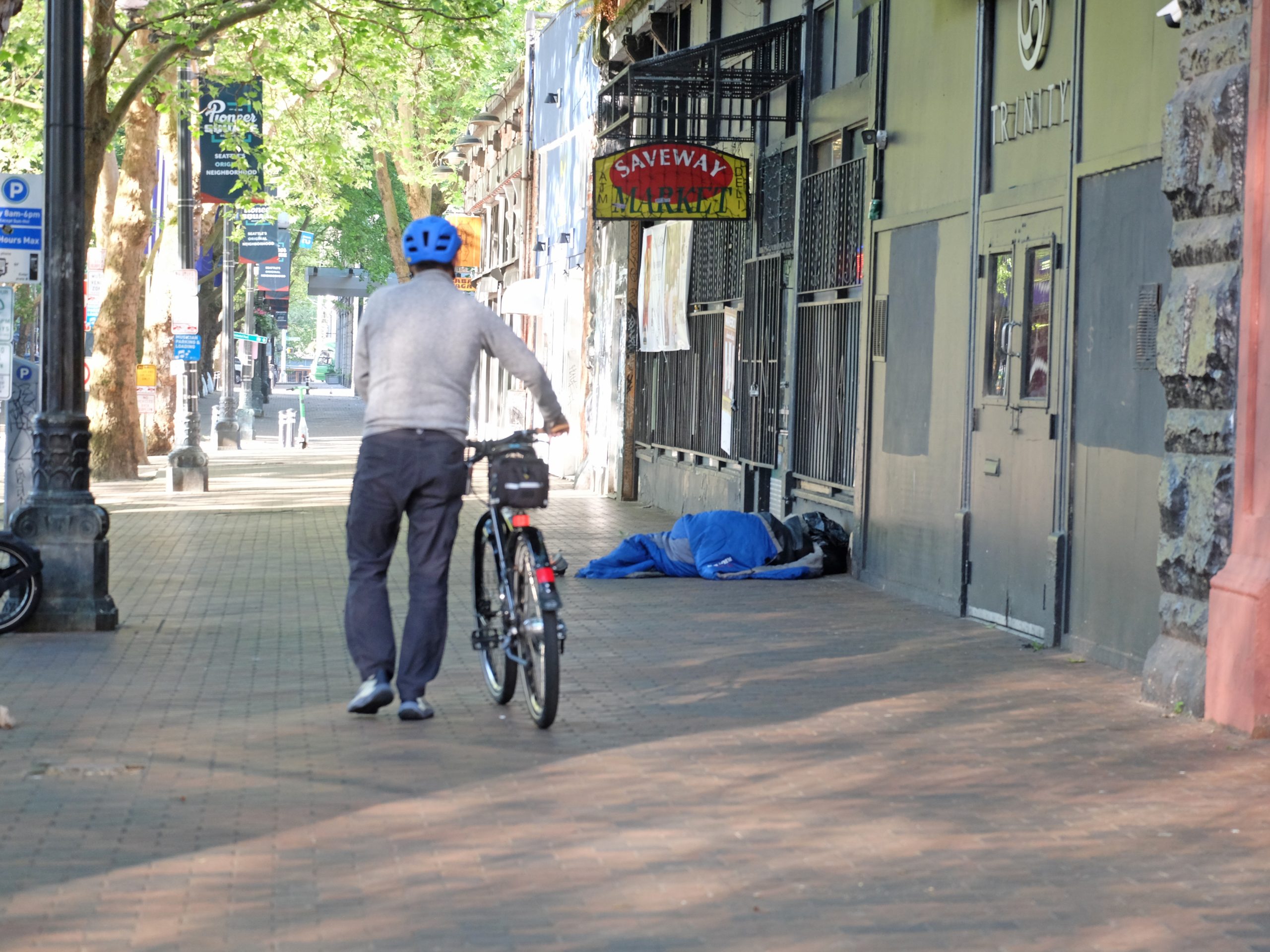
By the time he reached Third Avenue and Yesler Way in Pioneer Square, he was counting: two people sleeping in the open, two more he spotted through the opening of a tent pitched against a building. He noted what he could — descriptions, rough age, a name if someone was willing to give one. A few blocks on, he didn’t need to ask; he already knew the woman by name.
He met up with his counterpart, Jonathan, about an hour later, and the two compared notes, running down the map like a checklist. City Hall. Dilling Way. The pergola. By 8:30 a.m., they’d covered the neighborhood.
That was the point-in-time count — a walk the two DSA/MID ambassadors made for a month and a half, until late July, splitting Pioneer Square in half and tallying everyone who appeared to have slept outside overnight.
It was unglamorous, repetitive work. It was also the front edge of a much larger effort: the Streets-to-Housing initiative, a concentrated push by DSA, Purpose. Dignity. Action. (PDA), Community Solutions and numerous partners to identify everyone living unsheltered in a defined section of Pioneer Square, match each person to the right services and shelter, and track the results in real time.
In a little over a month, that effort moved 70 people off the streets and into interim housing, most of whom had been living outside for three years or longer, some for more than a decade. Organizers said it was also a test of whether a model built for one neighborhood could scale to solve a much bigger regional problem.
A six-week sprint
DSA President & CEO Jon Scholes lauded the effort and its early results in a LinkedIn post in late July.
- “With the support of national experts, Community Solutions, Inc. – the Downtown Seattle Association convened key service providers to help make a positive difference for people living on the streets of Pioneer Square and for the neighborhood, and to demonstrate an effective, data-driven model for moving people inside and getting them connected to critical services,” Jon wrote, before listing what was accomplished in the first six weeks:
- A list of people living outside in Pioneer Square was created
- Dashboards and data systems were developed so activities and outcomes were transparent to all involved
- Outreach workers established detailed information on individuals and matched them to services and interim housing
- A weekly count was conducted to track the number of people living outside
- Select 911 call data was tracked against a baseline to monitor neighborhood conditions
Jon credited PDA and all of DSA’s partners on this initiative: REACH, LEAD, CoLEAD, the Downtown Emergency Service Center, the Unified Care Team, the Pioneer Square Preservation District and the King County Regional Homelessness Authority, plus Seattle police and Seattle’s CARE Department for their support.
“We know how to do this,” Jon said. “Now it’s time to scale it to other neighborhoods. It’s not cheap, but the status quo is more expensive for all involved.”
By the numbers
Of 80 people on the by-name list, 70 were matched to interim housing and 62 were in it, per data compiled the week ending July 24. Four moved into permanent housing. On average, it took about 17 days from a person’s first engagement with an outreach worker to their placement in shelter — well ahead of the initiative’s 30-day target. This speed allowed the group to resolve an encampment along the new bike trail along Alaskan Way, outside of the original project area.
The population reflected the acuity of need in the neighborhood: 38 people on the list had been homeless for three years or more, seven for over a decade, and 62 had co-occurring health needs. Thirteen were seniors 55 and older, with the oldest person served at 76.
In a separate conversation about the initiative, Jon put it more plainly: the status quo wasn’t working, and Streets-to-Housing was built to get at the core of what actually did. That was proof, he said, that people who’d been unsheltered a long time could be moved indoors, and that temporary housing like tiny homes could go up quickly when the pieces came together.
With the World Cup bringing an influx of visitors and activity to the neighborhood this summer, providers worried that increased enforcement and crowding would simply push people out of Pioneer Square without getting them anywhere safer — scattering the problem rather than solving it.
“If we didn’t do anything, folks there would have been displaced,” said Sam Wolff, Seattle/King County policy director for PDA. “So we wanted to avoid that. From that perspective, we’re in a pretty great place.”
The initiative started with a target list of roughly 40 people before expanding to include others in the area, drawing in a wide roster of partners to pool outreach staff and data-tracking platforms and match people with whatever combination of shelter and services fit. Sam called it a demonstration of what was possible “with proper resources and a unified goal,” and said the project held up even in a neighborhood where outreach workers saw a higher-than-typical share of people with serious mental health needs and other barriers to coming inside.
Nichole Alexander, PDA’s director of special initiatives and outreach, described the pace behind those numbers: 12- to 16-hour days, teams in place before dawn on World Cup match days to reach people before enforcement began around 6 a.m., and constant coordination across organizations that didn’t share a single tracking system.
“There’s no universal system for tracking so many different spreadsheets and programs,” she said.
Not every outcome was a clean placement. Five people who had been part of the original count went missing during the effort — outreach teams searched for them daily — and two were incarcerated during the project window. Four people were connected to services where they were, without yet moving inside, which Nichole counted as a win. Some, she said, would need to change behaviors to succeed once they were in a shelter setting.
On the ground
For DSA/MID ambassador Jeffrey, who’s been with the organization for four years, the counts and day-to-day check-ins on the street were as much about relationship-building as data collection. He estimated he could hand someone a resource card in a doorway and, if everything went right, see them housed and employed within 90 days — “incredible,” he called it. “But,” he added, “that’s if everything goes right.”
He’s come to see addiction differently over his years on the job. “That first drink or first time to use might be a choice,” he said. “But that addiction isn’t.” Still, he said, plenty of people on his route were simply looking for a way inside. “There are people out here who truly want a hand. The tools are available; you just have to do some things for a bit.”
Jonathan, who joined the MID’s Community Safety & Hospitality Team five years ago, said the job had changed his outlook. “I’ve seen some people get in somewhere, and that’s very cool,” he said, candidly adding that not everyone who signed paperwork for a shelter bed followed through. “Trying to get people inside is always a good thing. We’re out here to help the people any way we can.”
“I feel good about myself at the end of the day,” Jonathan said, not only about his work on Streets-to-Housing but also as an ambassador. “Everyone is going through something, so if we can be around to make somebody’s day a little better, that’s great.”
What comes next
DSA’s dashboard displayed the Pioneer Square pilot as a proof of concept for a broader push: real-time data sharing between providers, a single point of coordination and an intensive, high-touch approach for a defined group of the highest-need individuals in a specific place.
Since wrapping up in Pioneer Square, Nichole and Sam have already taken the same approach to Ballard, where they’re seeing early success in pockets of the neighborhood — a first sign the model can travel beyond where it started. Leaders from all of the partner organizations are now meeting regularly to map out what a broader rollout could look like.
The open question, as Sam and Jon both framed it, wasn’t whether the approach worked — early results suggested it did. It was whether Seattle was willing to fund and staff it as more than a six-week sprint in one neighborhood, because unsheltered homelessness in the region doesn’t end when one neighborhood’s numbers look better.
Jon said a wider rollout could be funded through some combination of reallocated city budget and philanthropic support. To that end, the group sent a letter to Mayor Wilson outlining the approach to scaling this effort and replicating it in other City Council districts. It was an expensive proposition, he acknowledged — but the region, he argued, was already paying a steeper price for leaving the status quo in place.