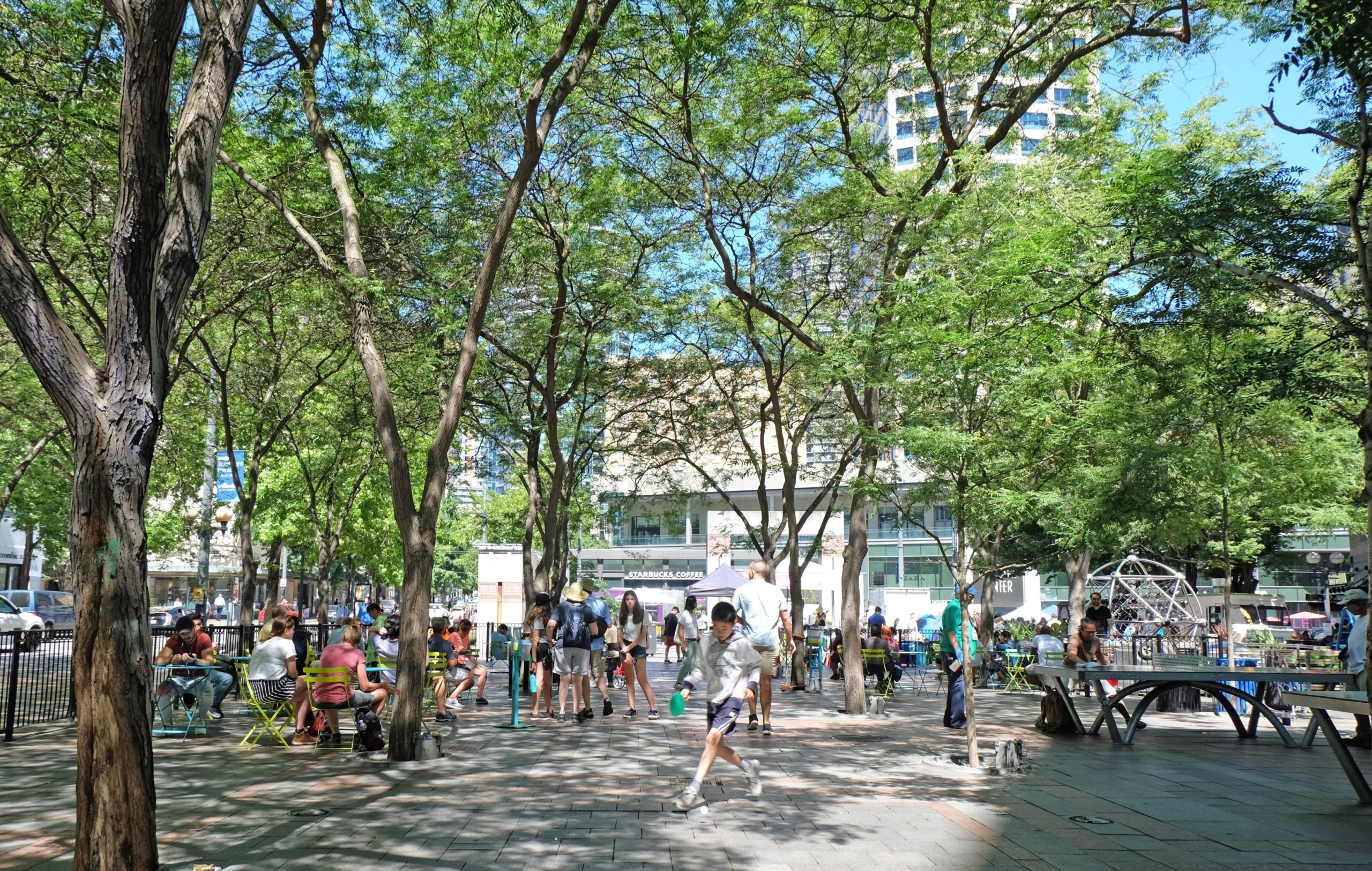
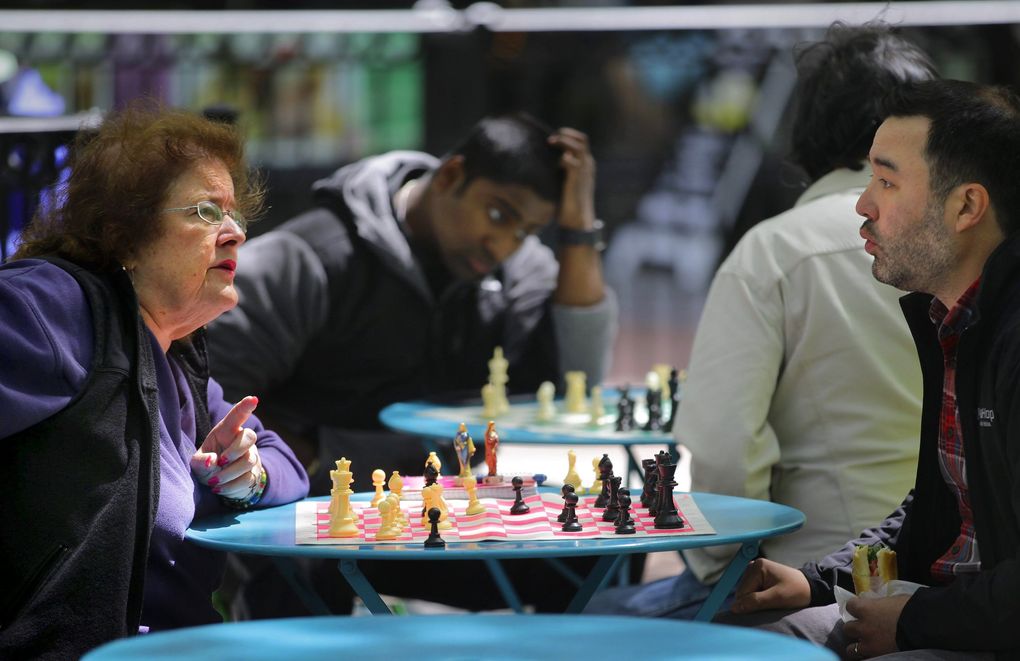
When Karen Schmidt visits the once-seedy Westlake Park in downtown Seattle a few times a week with freshly applied lipstick, she’s not looking for a handsome companion. Instead, the retired University of Washington staffer and former Nordstrom accountant is looking for a different kind of stimulation.
“I’m not looking for a boyfriend,” she likes to say. “I’m looking for casual chess.”
Schmidt has found it at the little pocket park with a checkered history in the heart of Seattle’s shopping district, just across the street from the monorail.
There, she takes her pink-and-white roll-up chess board, sets herself up at a table and waits for players to come to her.
Schmidt, who was introduced to the game as a child, is one of the few women among the regular chess aficionados at Westlake. The happiness she’s found there underscores two things: the unchanging, international lure of chess that transcends the divisions of politics, religion, race and money — though not always gender — as well as the transformation of the park.
Opened in 1988, Westlake has long been used as an unofficial town square. It’s been the stage for holiday festivities, celebrity appearances, political speeches and countless protests and marches. But it wasn’t exactly a desirable place to be much of the time, said James Sido, a spokesman for the Downtown Seattle Association.
Support for change at Westlake seemed to take shape in the years leading up to that letter. After protests over police accountability in the wake of the 2010 shooting of woodcarver John T. Williams by Seattle police Officer Ian Birk, some nearby residents and merchants felt the police pulled back from proactive enforcement there. In 2011, Occupy Seattle protesters used the 0.1-acre park as headquarters, covering nearly every square inch with tents and presenting city officials with a dilemma over First Amendment rights and public safety. And in 2013, a security guard at the Seaboard Building was robbed by a 13-year-old and attacked and beaten by a group of people while a park ranger watched.
The victim, Joseph Crudo, said at the time that it was not all that surprising. “You’ll see people sitting here, drinking and getting stoned all day, and then get into fights as night rolls around,” he told The Seattle Times then. “The police will be standing there, watching, but they won’t do anything unless there’s a felony … I’ve had officers say they won’t step in because they don’t want to be accused of violating someone’s civil rights.”
The Downtown Seattle Association began managing Westlake and Occidental parks, as well as several others, with city approval in 2015. Inspired by Dan Biederman’s renovation of Bryant Park in New York City, the association brought in furniture, play equipment, chess boards, pingpong tables and other activities that have created a “180-degree change,” Sido said.
“When you put in tables and chairs, amenities, security and live music you create a gravitational pull and make an asset out of a liability,” Sido said.
Souvik Cole, a chess player and a Westlake Center security guard who has seen the area’s transformation, said “having something to do here makes all the difference.”
Not that everything’s perfect. But around the chess tables, a diverse, quirky community has formed.
The park’s regulars include a handsome Russian fellow with what Schmidt calls a “wonderful accent”; an older Asian man who uses a wheelchair; a Hispanic man who takes the bus from Burien daily; a Native American man who says loudly, “That wasn’t very nice,” when she makes a good move; a pilot from Saudi Arabia who stops by when he’s in town; many immigrants from Africa, and people without indoor residences.
Schmidt learned to play chess from a neighbor boy when she was growing up in Yakima, but abandoned the game for years when he moved away. As a girl, she said, she was not encouraged to play.
Her love of the game was renewed when she taught her son to play when he was in third grade. He turned out to have a talent for it, beating her regularly by the time he was in grade four. His involvement in the scholastic chess circuit kept her head in the game for years. But as her son grew up and left home, she realized she missed the match of strategy and skill, and she set out to find a place to play.
She tried tournaments — once, in Lynnwood, she lost to a 10-year-old girl who was studying under Hungarian Grand Master Emil Anka — but she was looking for something more relaxed.
For a while, she’d drop in on the chess club at the University of Washington, where she worked. While that was fun, she said, she found the younger players were more into five-minute blitz chess than the traditional games she favors.
One day, while waiting for a book to be re-bound, she ducked into a Pioneer Square coffee shop and discovered to her great delight a coterie of chess aficionados.
She waited for an opening at a table, then sat down and asked the winner: “Can girls play?” (She has to ask because there are still men who won’t play women, she said.)
Eventually, her new friends suggested she check out Westlake Park, where she said she immediately felt at home.
“What they mean is, they don’t want to lose to a woman,” she said, laughing. “I don’t mind losing. I like to play better players because I want to keep learning.”
And that’s what she plans to do for as long as she can.