News
Economic Impact of the 12s: How Seahawks Super Bowl Parade Energized Downtown
Posted on
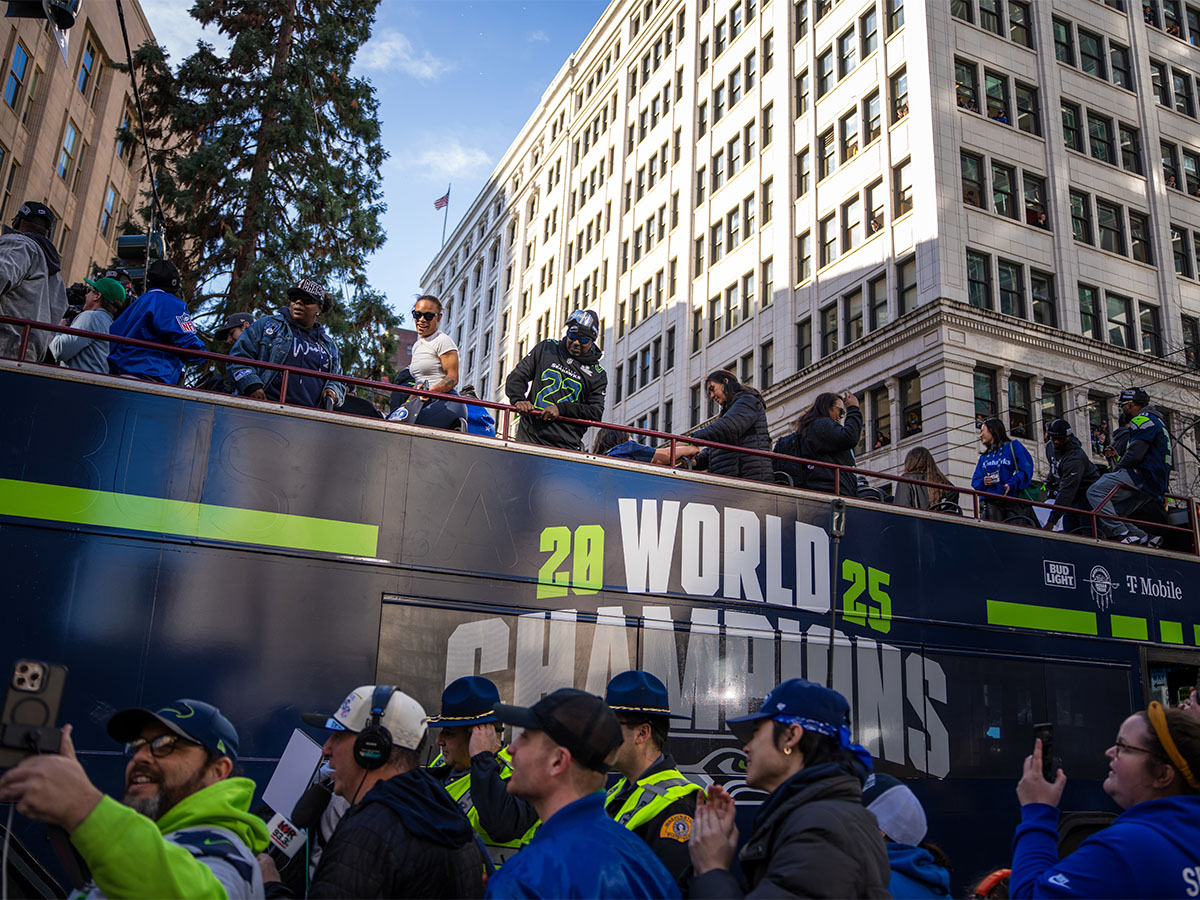
The confetti hadn’t fully settled on Fourth Avenue before the numbers started telling the story. When the Seattle Seahawks brought the Lombardi Trophy home on Feb. 11 — parading it more than 2 miles from Lumen Field to Seattle Center — they didn’t just give the city a moment to remember; they gave downtown a significant economic boost.
Three days after the Seahawks beat the New England Patriots 29-13 in Super Bowl LX in Santa Clara, 589,280 people attended the downtown Seattle championship parade, according to Placer.ai foot traffic data. The 12s, decked out in blue and green, flooded the blocks along Fourth Avenue, climbing lampposts, perching on building awnings and lining up 20 and 30 people deep just to catch a glimpse of the players, coaches and, of course, the Lombardi Trophy.
Getting there was its own feat of transit logistics: Sound Transit light rail carried 225,000 riders — shattering the agency’s previous single-day record of 159,500 — King County Metro buses moved 319,000 people and Lime bike and scooter riders totaled more than 57,000, nearly the same number of vehicles that cross the Aurora Bridge on any given day.
“It was a huge day for transit,” Sound Transit spokesperson Henry Bendon told KOMO News. “The Seahawks played in their Super Bowl on Sunday, we played in ours (on Feb. 11), and I think we all won.”
Bendon noted that planning for a potential parade had begun weeks earlier, once it became clear the Seahawks had a real shot. The expanded Link system made the coordination considerably more complex than in years past.
“The last time the Seahawks were in the Super Bowl, we went from the airport to Westlake,” he said. “Now we go all the way from Federal Way all the way to Lynnwood, which is a lot more system to cover.”
All of those people, of course, needed to eat, drink and spend.
Economic modeling from Datafy puts the parade’s estimated direct impact at up to $16,670,718.90, with paradegoers spending measurably more than usual on dining and nightlife (1.23x the average), clothing and accessories (1.56x) and fast food restaurants (1.13x). The average spend per visitor was $38.96.
“When downtown is activated, people show up, and the economic ripple effects are real,” DSA President & CEO Jon Scholes said.
Scholes noted that the energy extended well beyond parade day itself. Buoyed by two home playoff games at Lumen Field in January, the month ended with a 14% increase in unique visitors traveling more than 150 miles to downtown, with those two home-game weekends ranking as the busiest days of the month for long-distance visitation.
Hospitality impacts
For the hospitality sector, the parade was both a windfall and a logistical sprint. At The State Hotel on Second Avenue, General Manager Anne Johnson described a surge in demand that began almost immediately after the Seahawks’ Jan. 18 playoff drubbing of the San Francisco 49ers.
Johnson said peak timing occurred Tuesday, the day before the parade, with 66 rooms added that night alone, forcing a sellout. The parade generated an incremental 40 rooms and $13,000 in revenue, Johnson added, and the hotel’s restaurant revenue increased by 35% on parade day.
View this post on Instagram
Because the parade details were announced before 8 a.m. on the Monday following the Super Bowl, Johnson said they had little time to react before citywide inventory sold out. The parade also occurred during a week already saturated by Microsoft events and the AUTM Annual Meeting, creating more pressure on the hospitality industry to manage “the busiest day of 2026.”
“But when it rains, it pours in Seattle,” Johnson said with a smile.
The parade’s 11 a.m. timing also led to logistical challenges, Johnson said, and transportation hurdles as getting to work anywhere near downtown on the morning of the parade was a journey. Johnson also noted an increase in staff calling out sick that day, a common theme for any manager in the area.
Despite the challenges, Johnson’s takeaway was unambiguous.
“Overall, it was a win-win for the city, and the hotel, to have the parade downtown that day,” she said. “So let’s keep the championships going.”
A day to remember
While hundreds of thousands of fans filled the streets, another group was quietly doing what they always do: making sure downtown worked. DSA/MID ambassadors were deployed throughout the parade route and surrounding blocks, providing wayfinding, safety support and hospitality to the sea of 12s navigating the jam-packed city center. When the last float cleared Fourth Avenue and the celebration spilled into nearby restaurants, bars and plazas, they stayed, helping restore order to the blocks that had just hosted one of the city’s great civic moments.
The cleanup that followed was no small task. Seattle Public Utilities estimated more than 10,000 pounds of trash were collected in the aftermath — a number that speaks both to the scale of the crowd and the effort required to bring downtown back to itself.
The parade may have left behind 5 tons of trash, but it also left something else: a reminder of what downtown Seattle looks like when it’s the center of the sports world, even just for a morning.
“I got goosebumps just thinking about it,” Seahawks head coach Mike Macdonald said of the parade. “This is why we do what we do — to bring people together. We love the 12s. You guys are the best in the world.”